E-Commerce Marketing: A Complete Guide to E-Commerce Marketing
In today’s digital world, buying and selling products online has become an important part of modern business. Having an online store is not enough to generate sales. Businesses need to make sure that their products can be easily discovered by potential customers through search engines, social media, advertisements, and other digital channels. This is where E-Commerce Marketing plays an important role.
E-Commerce Marketing is the process of promoting an online store, products, and services through different digital marketing strategies. A well-planned e-commerce marketing strategy can help businesses increase website traffic, improve product visibility, generate sales, build brand awareness, and develop long-term customer relationships.
For students, digital marketers, business owners, entrepreneurs, and aspiring e-commerce professionals, understanding E-Commerce Marketing is an essential skill in today’s digital economy.
What is E-Commerce Marketing?
E-Commerce Marketing is a digital marketing strategy focused on promoting online stores and their products to potential customers through various online channels.
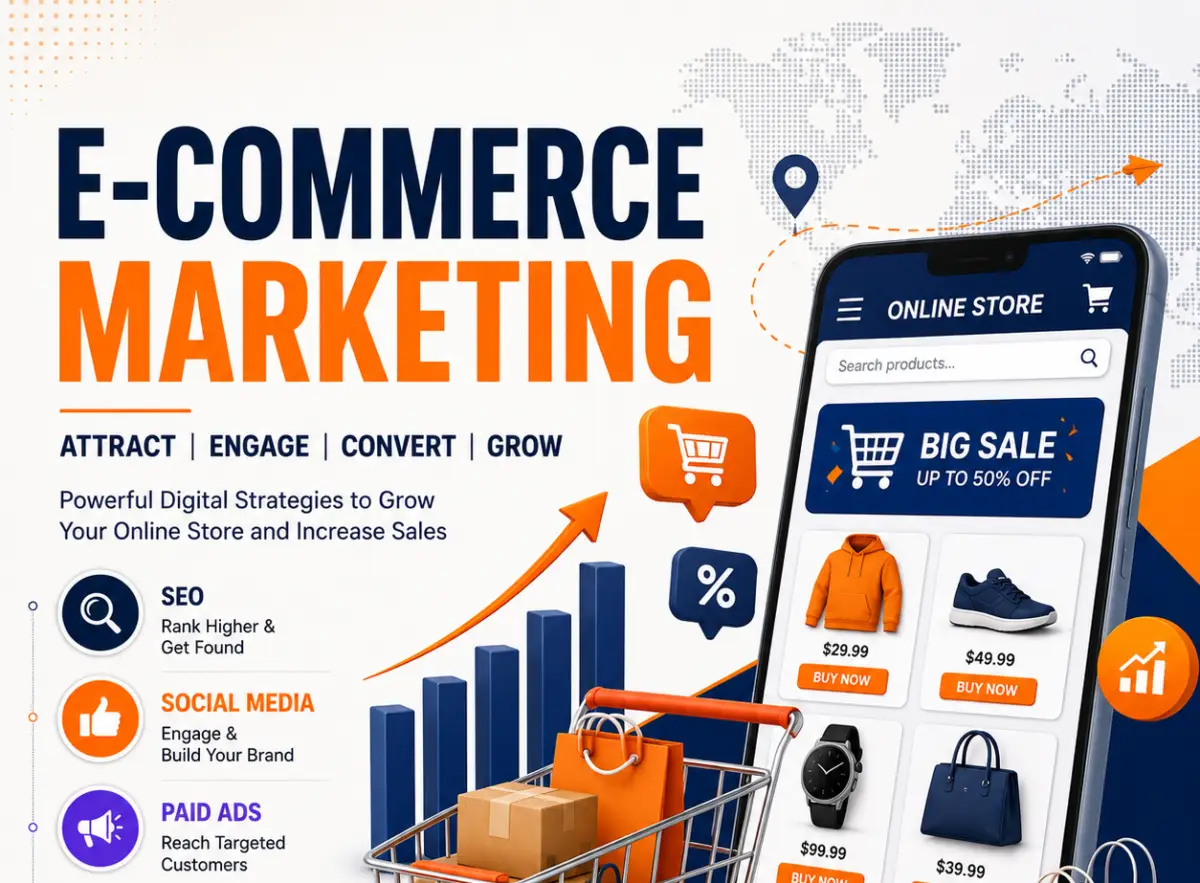
E-commerce marketers use strategies such as SEO, social media marketing, paid advertising, content marketing, email marketing, influencer marketing, and conversion optimization to attract customers and increase online sales.
Unlike traditional marketing, E-Commerce Marketing allows businesses to reach customers online, target specific audiences, measure campaign performance, and analyze customer behavior.
Why is E-Commerce Marketing Important for Businesses?
Most customers use the internet to search for products, compare prices, read reviews, and make purchasing decisions. If an online store does not have a strong digital marketing strategy, it may lose potential customers to competitors.
E-Commerce Marketing can help businesses:
- Increase online store traffic
- Improve product visibility
- Generate potential customers
- Increase online sales
- Build brand awareness
- Reach targeted audiences
- Improve customer engagement
- Increase repeat purchases
- Build customer loyalty
- Support long-term business growth
A successful e-commerce marketing strategy focuses not only on attracting visitors but also on converting visitors into customers and encouraging existing customers to purchase again.
How Does E-Commerce Marketing Work?
E-Commerce Marketing generally works through different stages of the customer journey.
Awareness
At the awareness stage, potential customers discover a brand or product through search engines, social media, advertisements, videos, or other online platforms.
Interest
After discovering a product, customers may visit the online store, explore product pages, compare products, read reviews, and learn more about the brand.
Consideration
At this stage, customers evaluate factors such as product quality, price, reviews, shipping, return policies, and brand reputation before making a purchase decision.
Conversion
The customer takes an action such as purchasing a product, submitting an enquiry, or signing up for an offer.
Retention
After the purchase, businesses can use email marketing, special offers, loyalty programs, customer support, and remarketing to encourage customers to return.
E-commerce marketing helps businesses manage the complete customer journey from product discovery to repeat purchases.
Major Types of E-Commerce Marketing
E-Commerce Marketing can be divided into several important areas.
1. E-Commerce SEO
E-Commerce SEO focuses on improving the visibility of an online store and its product pages in search engine results.
Important elements include:
- Keyword research
- Product title optimization
- Product description optimization
- Meta descriptions
- Image optimization
- URL optimization
- Internal linking
- Category page optimization
- Technical SEO
- Mobile optimization
- Structured data
- Website speed optimization
Good e-commerce SEO can help online stores attract relevant organic traffic from customers who are actively searching for products.
2. Social Media Marketing
Social Media Marketing involves promoting products and brands through social media platforms.
Businesses can use social media to:
- Promote products
- Share product videos
- Publish useful content
- Run promotional campaigns
- Engage with customers
- Build brand awareness
- Generate website traffic
- Collect customer feedback
Social media can be especially useful for visually attractive products such as fashion, beauty, food, lifestyle, and home products.
3. Paid Advertising
Paid Advertising allows e-commerce businesses to promote their products through paid advertising platforms.
Common types of e-commerce advertising include:
- Search advertising
- Shopping advertising
- Display advertising
- Social media advertising
- Video advertising
- Remarketing campaigns
Paid advertising can help businesses reach targeted audiences and generate product traffic quickly.
4. Content Marketing
Content Marketing involves creating useful and relevant content to attract potential customers.
E-commerce content can include:
- Blog articles
- Product guides
- Buying guides
- Product comparisons
- Tutorials
- Videos
- FAQs
- Infographics
- Customer stories
Instead of creating content only to promote products, businesses should focus on answering customer questions and helping them make better purchasing decisions.
5. Email Marketing
Email Marketing is an important strategy for building relationships with customers and encouraging repeat purchases.
E-commerce businesses can use email marketing for:
- Welcome emails
- New product announcements
- Special offers
- Product recommendations
- Abandoned cart reminders
- Order updates
- Customer feedback
- Repeat purchase campaigns
Email marketing can help businesses increase customer engagement and improve customer retention.
6. Influencer Marketing
Influencer Marketing involves collaborating with creators or influencers who have an audience relevant to the brand.
Influencers can promote products through:
- Product reviews
- Unboxing videos
- Tutorials
- Social media posts
- Short videos
- Live streams
Influencer marketing can help businesses increase product awareness and reach new audiences.
Product Page Optimization
Product Page Optimization is one of the most important parts of E-Commerce Marketing. Product pages provide customers with the information they need before making a purchase.
Important product page elements include:
- Clear product title
- High-quality product images
- Detailed product description
- Product specifications
- Product benefits
- Pricing information
- Customer reviews
- Clear call-to-action
- Shipping information
- Return policy
- Frequently asked questions
A well-optimized product page can improve customer experience and help increase conversions.
Keyword Research in E-Commerce Marketing
Keyword research is an important part of E-Commerce Marketing, especially for e-commerce SEO. It involves identifying the words and phrases people use when searching for products online.
For example, an online clothing store may target keywords such as:
- Buy men’s shirts online
- Women’s dresses online
- Best casual shirts
- Buy cotton shirts
- Men’s fashion online
- Affordable women’s clothing
When selecting keywords, e-commerce marketers consider factors such as search intent, relevance, competition, search volume, and potential business value.
Search Intent in E-Commerce
Understanding search intent is important for creating product pages and marketing content that matches what customers are looking for.
Search intent can broadly include:
- Informational Intent – The user wants to learn about a product or topic.
- Navigational Intent – The user wants to find a specific website or brand.
- Commercial Intent – The user is researching products before making a purchase.
- Transactional Intent – The user is ready to purchase a product.
Creating content and product pages according to search intent can improve relevance and help customers find the right products.
E-Commerce Content Marketing
Content plays an important role in e-commerce marketing because customers often need information before purchasing a product.
E-commerce content can include:
- Product descriptions
- Blog articles
- Buying guides
- Product comparisons
- How-to guides
- FAQs
- Product videos
- Customer testimonials
- Social media content
Businesses should focus on creating helpful, original, accurate, and customer-focused content instead of creating content only for promotional purposes.
E-Commerce and Mobile Optimization
A large number of customers use smartphones to browse products and make online purchases. Therefore, e-commerce websites should provide a smooth experience across mobile devices, tablets, and desktops.
Important mobile e-commerce practices include:
- Responsive web design
- Fast page loading
- Easy navigation
- Readable product information
- Mobile-friendly buttons
- Proper image sizing
- Simple checkout process
- Easy payment options
- Avoiding intrusive elements
A mobile-friendly online store can provide a better experience for customers and improve the chances of completing purchases.
E-Commerce Analytics and Performance Tracking
E-Commerce Marketing is an ongoing process. Businesses need to regularly monitor their online store performance and identify areas for improvement.
E-commerce professionals commonly track:
- Website traffic
- Product views
- Conversion rate
- Total sales
- Average order value
- Cart abandonment rate
- Customer acquisition cost
- Repeat purchase rate
- Customer lifetime value
- Advertising performance
- Revenue by marketing channel
Analytics tools can help businesses understand how customers discover products, interact with websites, and complete purchases.
Benefits of Learning E-Commerce Marketing
Learning E-Commerce Marketing can provide valuable skills for students, marketers, business owners, entrepreneurs, and freelancers.
Some major benefits include:
- Develops an in-demand digital marketing skill
- Helps businesses increase online sales
- Improves product visibility
- Creates freelance opportunities
- Supports digital marketing careers
- Helps improve website conversion rates
- Provides knowledge of online customer behavior
- Helps build and grow online brands
- Can be combined with SEO, social media, content marketing, and paid advertising
Career Opportunities in E-Commerce Marketing
After developing practical E-Commerce Marketing skills, learners can explore various career opportunities, including:
- E-Commerce Executive
- E-Commerce Marketing Specialist
- E-Commerce SEO Specialist
- Digital Marketing Executive
- Performance Marketing Executive
- Social Media Marketing Specialist
- E-Commerce Analyst
- E-Commerce Consultant
- E-Commerce Manager
- Digital Marketing Manager
With experience and a strong portfolio, e-commerce professionals can also work as freelancers or provide e-commerce marketing services to businesses.
How to Start Learning E-Commerce Marketing
Beginners can follow a structured learning path:
Digital Marketing Fundamentals → E-Commerce Fundamentals → Keyword Research → E-Commerce SEO → Product Page Optimization → Social Media Marketing → Paid Advertising → Content Marketing → Email Marketing → Analytics → Conversion Optimization → Advanced E-Commerce Marketing
Practical projects are important because they help learners understand how e-commerce marketing strategies work on real online stores.
E-Commerce Marketing vs Paid Advertising
E-Commerce Marketing and paid advertising are both valuable strategies, but they are not the same.
E-Commerce Marketing includes a wide range of activities such as SEO, social media marketing, content marketing, email marketing, influencer marketing, and paid advertising.
Paid Advertising focuses specifically on using paid promotional campaigns to reach potential customers.
Many e-commerce businesses use both approaches together. Paid advertising can generate immediate visibility, while SEO, content marketing, and customer retention strategies can support long-term growth.
Conclusion
E-Commerce Marketing is an essential part of modern digital business. It helps businesses promote their online stores, attract potential customers, improve product visibility, increase online sales, and build long-term customer relationships.
By learning E-Commerce SEO, keyword research, product page optimization, social media marketing, paid advertising, content marketing, email marketing, analytics, and conversion optimization, aspiring digital marketers can develop a strong foundation for a career in e-commerce.
Whether you are a student, business owner, entrepreneur, freelancer, or digital marketing professional, learning E-Commerce Marketing can help you understand how online businesses attract customers and grow their sales through digital channels.